When the Campus Stops Being a Neighbor: Land, Police, and the New Town-Gown Divide
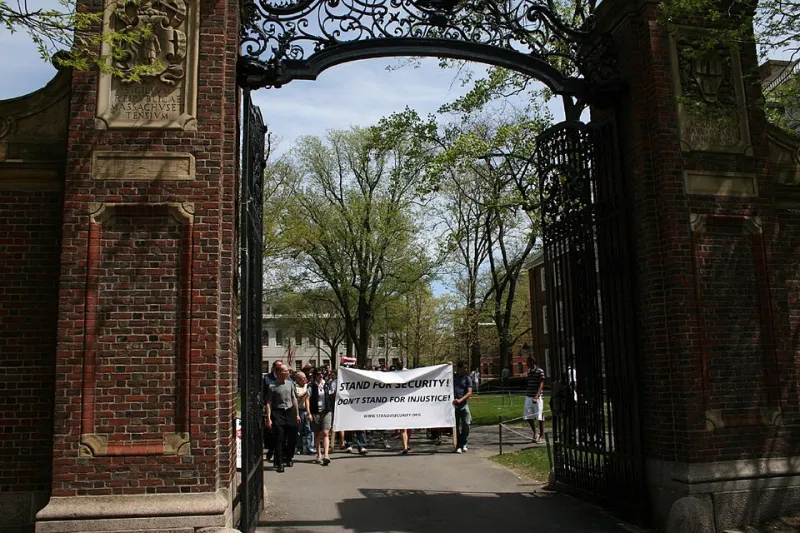
Photo: stand4security on Flickr, CC BY 2.0, via Wikimedia Commons
The ivory tower was never meant to be an architectural blueprint. It was a metaphor, a jab, a way of describing scholars so far removed from ordinary life that they could not see the street below. Yet drive through any number of American college towns today and you will find the metaphor made concrete: gated quads, private forces, and real estate portfolios that swallow whole blocks. Higher education did not merely drift from its neighbors. It walled itself off, and it paid for the wall with the neighbors' patience.
Buying the Block, One Parcel at a Time
Consider the expansion playbook that has become standard at public flagships and private elites alike. A university foundation, often a separate legal entity, acquires property through a subsidiary. The parcel comes off the tax rolls. The city loses revenue but gains obligations — more students, more traffic, more demand for services the institution itself does not fund. In State College, Pennsylvania, the university's footprint and the borough's budget have long been locked in a quiet struggle over who pays for the consequences of a campus that functions like a mid-sized city. In New Haven, Yale's holdings and its voluntary payments to the city have been a running negotiation for decades, with mayors periodically forced to make the public case that the state's largest employer should contribute more than goodwill.
This is not villainy; it is strategy. Universities behave like any large landowner when the incentives point that way. But the cumulative effect is a civic arrangement in which the institution captures the benefits of urban adjacency — culture, restaurants, labor, transit — while deflecting the costs. Town-gown friction is usually narrated as culture war: rowdy students, resentful locals. More often it is a fiscal dispute wearing a costume.
The Police Blotter Problem
Then there is enforcement. A growing number of campuses operate accredited police departments with arrest powers that end, abruptly, at an imaginary boundary. On one side of that line, a university officer; on the other, a municipal one. Residents who live in the shadow of campus learn which force answers when they call, and the answer is rarely the one with local accountability.
The pattern is not abstract. In communities around the University of Chicago and the University of Southern California, private security arrangements have expanded into surrounding neighborhoods, sometimes welcomed by residents exhausted by crime, sometimes resented as an occupying presence with no elected oversight. Either way, the result is the same: the university becomes a quasi-government, providing a public good — safety — on its own terms, to its own standards, answerable to its own board. That is a remarkable amount of sovereign power for an institution whose core business is credentialing eighteen-year-olds.
Three Cities, One Lesson
Athens, Georgia, Ithaca, New York, and New Haven offer three variations on the same theme. Athens has wrestled with a commission form of government in which the county and the university share a name, a downtown, and a chronic tension over development. Ithaca's tax base is so dominated by Cornell that the city's fiscal health rises and falls with a landlord it cannot tax effectively. New Haven's negotiations with Yale have produced payments, but only after years of public pressure that no city of fifty thousand could easily sustain.
In each case, the conflict did not begin with hostility. It began with asymmetry. One party owns land, police, and lawyers; the other owns a zoning board and a grievance.
The Survival Case for Lowering the Wall
Defenders of the status quo note, correctly, that universities are legally entitled to their exemptions and their foundations. But entitlement is not the same as sustainability. The demographic cliff bearing down on higher education means institutions will soon be competing for students, state appropriations, and public goodwill in ways they have not for a generation. Public opinion of higher ed is already soft. A university that treats its host city as a resource to be extracted is accumulating a liability no endowment can hedge.
The reform agenda is unglamorous but clear. Voluntary payment agreements should be formalized, indexed, and independently audited rather than renegotiated like hostage releases every decade. Campus police should share data, dispatch protocols, and oversight with municipal authorities. Land acquisitions should trigger genuine community benefit processes, not the perfunctory hearing that precedes a done deal.
The institutions that thrive in the coming decade will not be those with the tallest towers. They will be the ones that remembered the street below — and paid for the privilege of standing on it.