The Podium Ledger: Who Signs the Checks Behind the Commencement Microphone
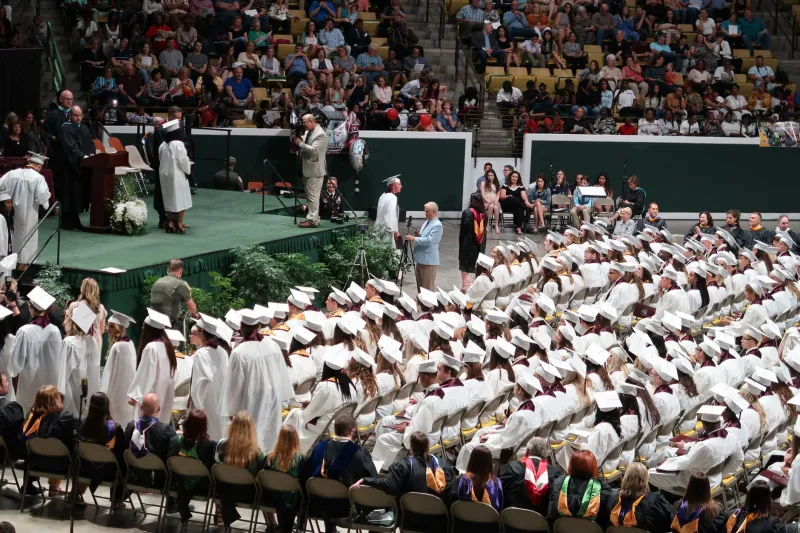
The commencement speaker occupies a peculiar spot in the American university's economy. For twenty minutes of remarks — much of it borrowed from the last three ceremonies — the institution pays what a contingent instructor earns over multiple semesters of teaching. The transaction is rarely advertised, almost never itemized, and, at public flagships across the country, increasingly difficult to reconcile with the payroll two floors down.
The Fee Nobody Puts on a Tour
Ask a provost's office what a speaker costs and the answer tends to arrive in fragments: an honorarium "waived," travel "covered by the foundation," a gift "customary." Assemble the fragments and a pattern emerges. Celebrity speakers with name recognition that fills a stadium — former presidents, broadcast anchors, A-list actors — can command $100,000 or more through agencies that treat the campus circuit as a market like any other. Even mid-tier names, the ones who appear plausible on a program, often draw five figures before a single thank-you note is written.
The mechanics of payment are deliberately unglamorous. Funds frequently route through university foundations, which sit outside the disclosure requirements that govern public appropriations. A speaking fee becomes a "donor-sponsored gift." Business-class airfare becomes "protocol travel." What would raise eyebrows as a line item becomes, in the foundation's ledger, a gesture of hospitality.
A Public-Records Pilgrimage
Because flagships are public bodies, a determined reporter can reconstruct much of this spending through open-records requests — contracts, reimbursement forms, flight itineraries. What those documents reveal is an arms race. Once one flagship in a conference books a marquee name, its peers feel the gravitational pull. Presidents, sensitive to how a ceremony photographs, want the podium stocked. The speaker becomes a branding exercise: proof the institution belongs in the company of schools that can afford one.
The competition is quiet but real. Speaker bureaus report that spring demand from universities has grown even as state appropriations have not. The result is a market in which the buyer — a tax-supported institution — helps bid up a price it then describes as unavoidable.
Follow the Approval Chain
Who signs off? Rarely the faculty. In most cases the decision travels from the president's office to the foundation's events staff to whichever donor or corporate partner is underwriting the visit. Trustees may learn the name when the program is printed. The faculty senate, the body nominally responsible for the academic character of the ceremony, is consulted on protocol, not price.
This governance gap matters. Universities have elaborate approval chains for a $3,000 travel reimbursement from a research grant. A six-figure speaker package can move through a foundation with fewer checkpoints than a department's coffee budget.
The Adjacent Arithmetic
Set the speaker's invoice beside the institution's own wage data. At many flagships, a single marquee honorarium exceeds the annual salary of an adjunct teaching a full load — often by a wide margin. The comparison is not a demand that celebrities teach freshman composition. It is a question of institutional memory: what a university chooses to celebrate, and what it chooses to forget, when the two costs appear in the same fiscal year.
Defenders of the spending offer familiar rebuttals. Speakers inspire students. Donors, not taxpayers, pay the freight. The ceremony is a marketing asset worth the outlay. Each argument contains a grain of truth and a convenient omission. Donor money is fungible; a dollar spent on a podium is a dollar not endowed for instruction. And the inspiration argument collapses under its own asymmetry: the institution that pays a celebrity $100,000 to address graduates for twenty minutes will often decline to pay the instructor who taught those same graduates for four years a salary that keeps them off public assistance.
What Reform Would Actually Look Like
None of this requires the abolition of commencement. It requires sunlight and proportion. Public flagships should disclose speaker compensation — honoraria, travel class, foundation routing — in a standard annual report, the way athletic subsidies now must be. Boards should adopt a simple ratio policy: no speaker package exceeding a defined multiple of the institution's median contingent salary. And faculty senates should claim a seat at the table, not to veto names but to insist the ceremony reflect the institution's actual intellectual labor.
Some campuses have already discovered that the best-remembered speeches often come from alumni, longtime professors, or students themselves — at a cost rounding to zero. The podium did not need a price tag to carry weight. It needed someone behind it who belonged there.
The robes are heavy. The question is who is carrying them.