The Paper Campus: How Compliance Became Higher Education's Fastest-Growing Discipline

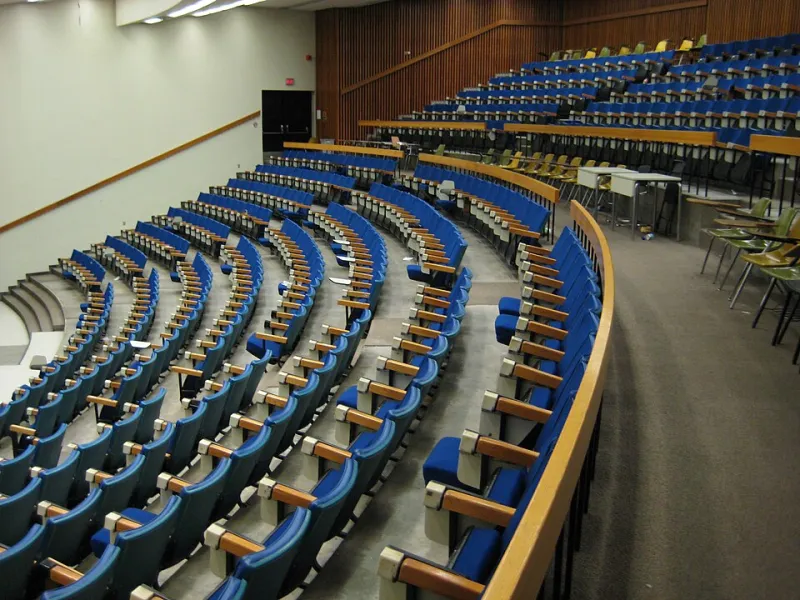
Photo: Dietmar Rabich, CC BY-SA 4.0, via Wikimedia Commons
Somewhere in the basement of a midwestern public university, a staff member whose job title includes the word 'liaison' is compiling a report that no student will ever read and no faculty member will ever cite. It will be filed with an accreditor, cross-referenced with a federal regulation, and archived until the next reporting cycle makes it obsolete. Multiply that task across dozens of offices, hundreds of forms, and thousands of hours, and you begin to glimpse the hidden institution inside every American university: the compliance campus.
Counting the Uncountable
No national dashboard tracks how many university employees exist primarily to satisfy regulators, accreditors, and federal statutes. But piecing together org charts, budget documents, and public records from three comparable mid-tier institutions — a regional public, a private master's university, and a former teachers' college — a pattern emerges that is difficult to dismiss.
At each of the three, compliance-adjacent staffing grew faster than instructional staffing over the past decade. The regional public added a Title IX office that did not exist in 2011; it now employs nine full-time staff, including two investigators and a prevention-education coordinator. The private university's accreditation function migrated from a part-time duty housed in the provost's office to a standalone 'Institutional Effectiveness' division with its own budget line. The teachers' college, facing a state audit, created three new positions in a single year — none of them in a classroom.
This is not necessarily waste. Title IX offices exist because students were once abandoned by the institutions that took their tuition. Clery Act reporting exists because a young woman was murdered at Lehigh in 1986 and the university said nothing. The laws that generate this paperwork were written in response to real failures.
But somewhere between accountability and administration, a third thing appeared: a permanent professional class whose institutional loyalty runs not to students or scholarship, but to the filing deadline.
The Career Nobody Planned
What makes the compliance sector distinctive is not its size but its self-sustaining character. Faculty lines shrink when budgets tighten; compliance lines rarely do, because the underlying obligations never expire. An accreditation liaison cannot be made redundant while accreditation exists. A Clery report must be filed every year, forever.
The people who hold these jobs are often capable administrators who did not set out to become professional form-fillers. Several described their trajectory in similar terms: a staff position in student affairs, a regulation that landed on their desk, and a slow accretion of duties until the original job disappeared beneath the regulatory one. One coordinator at the private university put it plainly: 'I haven't spoken to a student in fourteen months.'
There is a labor story here, too. Compliance work is salaried, stable, and benefits-eligible — precisely the kind of employment that contingent faculty have watched evaporate from their own ranks. The university is not shrinking its workforce; it is re-sorting it, trading the tenure track for the reporting stack. The growth is real, but it is growth of a particular kind: employment that answers upward rather than outward.
A Discipline Without a Syllabus
The most revealing finding from the three institutions is how compliance work has begun to generate its own academic apparatus. Accreditation self-studies now consume months of faculty labor. Assessment offices require departments to document 'student learning outcomes' in formats that mimic scholarship without performing its function. Professional associations, journals, and certification programs have formed around the work, complete with their own conferences in hotel ballrooms near airports.
It is tempting to call this bureaucratic bloat and move on. But the deeper question is what it does to the institution's sense of itself. A university that spends its self-study explaining its processes rather than examining its purposes is rehearsing a particular kind of identity: the school as a regulated entity first, an educational one second. Students sense this. Faculty, asked to write assessment reports instead of reading groups, sense it more acutely.
What Reform Would Actually Require
Nobody serious proposes abandoning Title IX enforcement or shuttering accreditation. The question is whether the current architecture — decentralized, duplicative, and endlessly self-documenting — is the only way to meet those obligations. It is not.
Consortial compliance, in which groups of institutions share accreditors' documentation costs, exists in a few regions and works. Consolidating overlapping federal reporting requirements, an idea floated in every higher-ed reauthorization debate for twenty years, remains unfixed. And a simple rule of institutional design — that any new compliance function must come with a sunset review — would at least force the question of whether each office still earns its keep.
The universities profiled here are not villains. They are rational actors responding to a regulatory environment that rewards documentation over judgment. But rational responses, multiplied across four thousand institutions, produce an unintended result: a sector that employs more people to explain itself than to teach. The fastest-growing discipline on the American campus has no majors, no faculty, and no graduates. It only has paperwork — and it is always due.