Syllabus by Statute: How Two English Departments Learned to Live With Mandated Reading Lists
Photo: Garden Sprite, CC0, via Wikimedia Commons
The memo arrived at both departments in the same week of August, though neither faculty knew the other existed. One came from a provost's office in a large red-state flagship, forwarding the text of a newly passed general education statute requiring undergraduates to encounter a canon of 'foundational Western texts.' The other came from a blue-state flagship, where trustees had just adopted a requirement that every general education course include 'diverse and inclusive perspectives' — a mandate with teeth, enforced through program review.
Both documents ran to several pages. Neither mentioned staffing, compensation, or the graduate instructors who would do most of the teaching. In that respect, at least, the legislatures and boards agreed.
The View from the Red State
At the first flagship, which officials asked not be named given ongoing legislative scrutiny, the department chair spent the fall semester doing something she described as 'translation work.' The statute named no specific books, but a companion resolution from a legislative committee circulated a list: Plato, Augustine, Shakespeare, Milton, Tocqueville. Faculty in the department read the list with reasonable affection — most of them had doctorates in exactly this material — and with reasonable alarm at what its adoption would signal.
'The texts were never the problem,' one associate professor told me. 'The problem is that my syllabus is now a press release for somebody's campaign.'
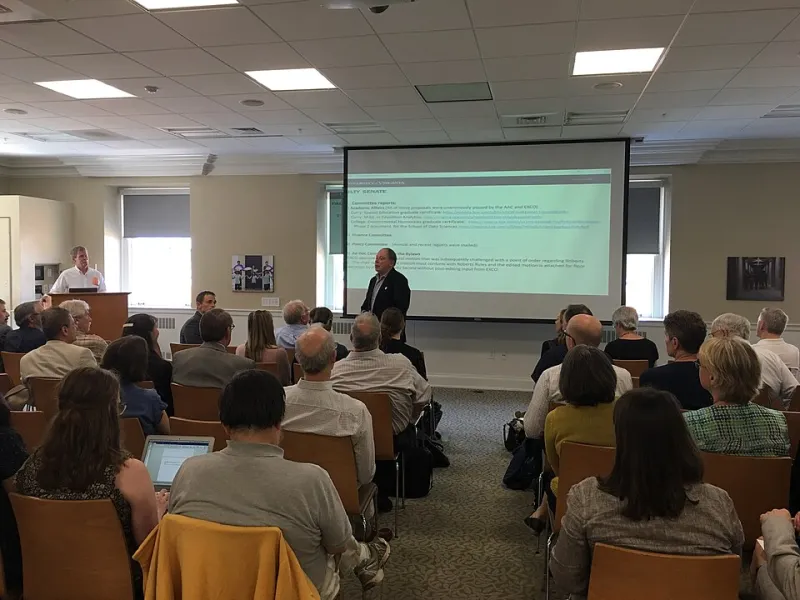
The department's solution was characteristically academic: a seminar. Over three Friday afternoons, twenty-odd faculty and graduate students debated how to satisfy the mandate without surrendering the premise that a curriculum is built by people who study for a living. The compromise they reached was elegant. Courses would anchor themselves in canonical texts — the statute was, after all, the law — but each would pair its anchors with counterweights: Baldwin against Emerson, Woolf against Arnold, a contemporary Indigenous poet against Whitman. Nothing in the statute prohibited footnotes.
Whether the arrangement survives the next legislative session is an open question. A bill introduced in January would require public institutions to report 'course materials compliance' to a state council. The department's counterweights would be easy to find there.
The View from the Blue State
Two thousand miles away, the second department faced a mandate with the opposite valence but a similar structure: a requirement handed down from above, without new resources, measured by compliance rather than learning. Faculty there reported a different kind of fatigue. Nobody objected to inclusive syllabi — many had taught them for decades — but several bristled at the paperwork architecture that accompanied the requirement, the outcome-mapping exercises and syllabus certification forms that turned a curricular commitment into an administrative audit.
'You can mandate a book list, and you can mandate a rubric,' one senior lecturer said. 'What you cannot mandate is a semester that works. That part we're on our own for.'
The blue-state department also negotiated, though its negotiations happened in curriculum committee rather than in response to a statute. Instructors were given wide latitude in text selection, which many experienced as freedom and some experienced as abandonment: no shared canon means every adjunct assembles a course from scratch, every year, for per-course wages that hover near the poverty line in the state's largest metro.
The Shared Ground
Set the politics aside and the two departments look remarkably alike. In both cases, a curricular decision was made by an authority with no teaching obligations; in both, the interpretive labor — deciding what the mandate means, line by line, week by week — was absorbed by contingent and junior faculty. In both, the genuine intellectual questions at stake, including what a freshman should read and why, were displaced by questions of institutional risk.
This is the pattern that deserves attention from anyone concerned with the condition of academic labor. Curriculum wars are fought rhetorically in statehouses and op-ed pages, but they are worked out practically in Friday-afternoon seminars and unpaid course redesigns. The faculty who bear that work rarely appear in the coverage. Their departments, in both states, have become sites of quiet institutional repair — not because anyone appointed them to the task, but because no one else will do it.
What a Solution Would Require
There are modest proposals worth taking seriously. General education mandates, whatever their ideological content, should arrive with funding proportional to their scope. Curricular authority should rest with faculty senates, with legislative input exercised through oversight of outcomes rather than prescriptions of texts. And institutions should count the labor of mandate implementation in workload calculations, rather than treating it as an act of professional devotion.
Neither statute, red or blue, will determine what a freshman actually learns. That determination gets made in a classroom by an underpaid instructor with a mandated list in one hand and forty years of teaching judgment in the other. The least the mandators could do is notice.