Words That Do the Work: How Administrative Vocabulary Absorbs the Cost of Cheap Labor

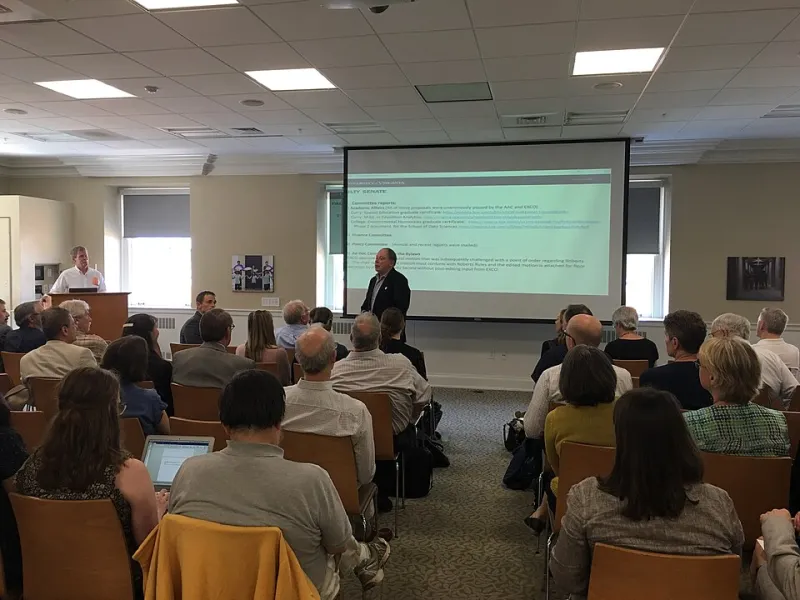
Photo: Theonlysilentbob, CC BY-SA 3.0, via Wikimedia Commons
Administrative English is a functional language. Like any functional language, it is optimized for a purpose, and in the modern American university that purpose is rarely clarity. It is, more often, the management of embarrassment.
Higher education employs somewhere in the neighborhood of a million part-time and non-tenure-track instructors, many earning per course what a full professor earns per week. No institution likes to put that arithmetic in writing. So the sector has evolved a vocabulary — precise, anodyne, endlessly repeated — that allows budget offices, provosts, and human resources departments to describe precarious labor without ever sounding like they are describing precarious labor. Below, a reader's guide, drawn from actual postings, handbooks, and policy documents.
Adjunct
The oldest term in the lexicon, borrowed from Latin adjungere, 'to join.' The word implies an addition to something essential. In practice, at many institutions, contingent instructors constitute the majority of the teaching workforce. A community college in the Midwest recently advertised a ' adjunct faculty pool' — a body of applicants held in reserve, paid per credit hour, with no guarantee of a section to teach until days before the semester begins. The pool metaphor is apt: instructors wait in it.
Contingent Faculty
The honest term, ironically, and therefore the one used least in public-facing materials. 'Contingent' appears frequently in internal documents and accreditation self-studies, where candor is legally difficult to avoid. Its virtue is that it names the condition — employment contingent on enrollment — while quietly relocating the contingency onto the worker. The schedule is contingent. The income is contingent. The institution, grammatically speaking, is never the contingent party.
Course Redistribution
A phrase that surfaces in departmental memos when enrollment dips or a tenure line is frozen. Sections once assigned to a departing lecturer are 'redistributed' — a word suggesting the careful sorting of donated goods. What is actually redistributed is work: three sections that paid one person's rent are divided among three people already teaching four sections each. No one's load increases; the arithmetic simply spreads thinner.
Flexible Instructional Delivery
Found in strategic plans and accreditation documents, usually alongside words like 'innovation' and 'student-centered.' It can mean online teaching, hybrid scheduling, or evening and weekend sections. What it reliably means is that the person delivering the instruction is paid the same flat rate regardless of format, preparation time, or the 6 a.m. commute to an 8 a.m. section. Flexibility, in this dialect, flows in one direction only.
Guest Lecturer
A title that evokes a distinguished visitor, a seminar, perhaps a catered lunch. In job postings it more often denotes a one-semester appointment with office hours held in a shared room and a mailbox that may be a folder. One New England liberal arts college's posting for a 'visiting guest lecturer in writing' required a PhD, three letters of recommendation, a teaching statement, and offered a stipend that, divided by the number of expected contact hours, fell below the state's minimum wage. The word 'guest' does a great deal of work there.
Professional Practice
Appears in descriptions of teaching appointments held by working practitioners — admirable people, often, who bring field experience to the classroom. But 'professional practice' has also become a way to classify instructors as something other than academics, exempting them from governance, research support, and the salary scales that come with the faculty title. A practice, the terminology suggests, is not a career. Careers require commitment; practices can be paused.
Special Faculty
A genuine head-scratcher from a large public university's org chart, where 'special faculty' designates full-time non-tenure-track instructors on renewable one-year contracts. Special in what way? The adjective appears to mean: not eligible for sabbatical, promotion review, or multiyear appointments. It is the administrative equivalent of a participation trophy — recognition without security.
Temporary, Part-Time, Non-Essential
The final euphemism is not a word but a structure. In one state system's recent budget reduction plan, instructors were listed under 'non-permanent staffing adjustments,' a category that also included landscaping contracts and software licenses. Faculty members discovered their own employment status by reading a spreadsheet. When labor is classified alongside procurement, the euphemism has done its work: the person has been fully converted into a line item.
Why the Language Holds
Defenders of this vocabulary will note, correctly, that no term is a lie. 'Contingent' is accurate. 'Flexible' is accurate. Euphemism rarely falsifies; it redistributes attention. The effect is cumulative. A job posting that says 'adjunct' rather than 'instructor paid $3,200 per course with no benefits' is not deceiving anyone, exactly. It is simply declining to lead with the number.
Language, in the academy, is supposed to be the thing we do best. The sector's critics on the left and right agree on remarkably little, but both have noticed that the institutions most devoted to critical inquiry have developed a corporate dialect of remarkable evasive power. Reform, when it comes, will likely begin the way these things usually do — with someone insisting on plainer words. Call the position what it is. Publish the per-course rate. Let the vocabulary match the payroll.
Until then, the glossary grows. Somewhere a strategic plan is being drafted that refers to instructors as 'educational partners' or 'learning facilitators.' When it appears, add it to the list. The list, unlike the appointments it describes, shows every sign of being permanent.