The Geography of Regard: Reading a University's Priorities in Its Parking Lots
Every American campus publishes a hierarchy of personnel — deans above chairs, tenured above visiting, visiting above adjunct — but the paperwork is polite about it. The parking map is not. There, in plain black and white, is the university's actual opinion of its people, expressed not in words but in yards.
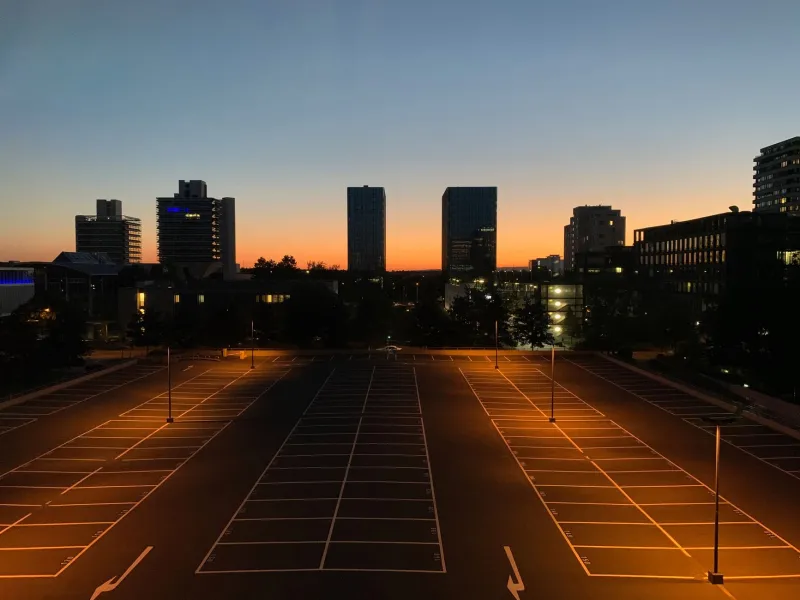
Consider the typical public flagship. The executive officers hold permits for a structure attached to the administration building, complete with elevators and, in the colder states, covered passage. Full professors occupy the surface lots nearest the quads. Lecturers and full-time non-tenure-track faculty are pushed to the perimeter. And the adjuncts — the people now teaching more than half of undergraduate credit hours nationally — walk from a gravel field beyond the stadium, past the maintenance depot, often without lighting for evening classes and frequently without a shuttle after six o'clock, which is precisely when most of their sections meet.
The Most Honest Document on Campus
Universities are fluent in the language of stated values. Strategic plans speak of student success, inclusive excellence, and the teacher-scholar model. Parking is where those values are cashed out. A permit fee schedule is a budget of belonging: it tells every member of the community, on day one, exactly how far they are expected to stand from the institution's center.
This is not a conspiracy so much as an arithmetic. Reserved spaces near the core are scarce, and scarcity gets rationed by power. But that is the point. Rationing by power is a decision, and decisions can be examined. When a campus claims its adjunct faculty are central to its mission while assigning them a twenty-minute walk from the classrooms they teach in, the walk is the claim that counts.
The economics sharpen the irony. A part-time instructor paid $3,000 a section may spend a meaningful fraction of that paycheck — often after taxes and a commute from across town, since adjuncts rarely earn enough to live nearby — on the privilege of parking far away. The permit fee is regressive by design: the lowest-paid person on campus frequently pays the highest effective rate per hour of presence.
Follow the Walk
Readers who work on campuses can conduct the exercise themselves. Start at the most remote lot and walk toward the center, noting where the categories change. Where do the cleaning crews park? Where do the graduate students — who often both teach and pay tuition — land? Where does the visitor's lot sit, and how does its proximity compare to that of the people who will still be there in twenty years?
The pattern rarely tracks seniority in the conventional sense. It tracks proximity to money and to exit. Administrators, whose tenure in a given post averages a few years, get the closest spaces. Adjuncts, many of whom have taught at the same institution for a decade or more, get the farthest. The geography rewards transience and penalizes persistence — a strange incentive structure for institutions that claim to prize continuity and mentorship.
There are exceptions worth naming. Some community colleges, operating on leaner budgets and a heavier teaching load, have quietly flattened their maps: one permit, one price, first-come spaces, the president's spot unmarked. These are not wealthy institutions. They are simply ones where the distance between the parking lot and the professed mission happens to be short.
What Reform Would Actually Cost
Defenders of the status quo note that space near the core is finite, and they are right. But the remedies are neither mysterious nor expensive. Weight permits by teaching hours rather than job title. Reserve the nearest open lots for those who teach the most sections. Fund lighting and shuttle service on the perimeter routes, which benefits students as well as staff. Above all, publish the map — every campus already has one — alongside the salary bands it corresponds to. Sunlight, in this case, is literal: well-lit lots are a safety issue, and adjuncts teaching evening sections deserve them as a baseline, not a concession.
None of this solves the underlying problem, which is a compensation model that treats a third of the instructional workforce as piecework. But physical space is a place to start because it is the one arena where the hierarchy is visible without a records request. A provost cannot claim ignorance of a gravel lot.
The invitation, then, is simple. The next time a campus community debates its values, skip the retreat and take the walk — from the farthest space to the nearest door. Count the minutes. Then ask who is being told, one hundred yards at a time, what they are worth.